Homes in Glendale, CO built through the fifties and sixties were wired for a fraction of the load a household runs today, and the network of electrical contractors in Littleton serving this area sees the results every week: panels with no room left, outlets that warm up under normal use, and circuits that trip when two appliances share them. Reaching those panels and running new circuits through finished walls calls for professional electrical panel upgrade work matched to how these houses are actually built.
Homeowners here call a local electrician rather than a general one because the details of these houses - where the panel sits, what is under the floor, how tight the walls are - change what every job actually involves.
Knowing Glendale Homes Changes Every Job
A local electrician working in Glendale knows that most of these houses carry their panel in a utility closet or on an interior wall, that the floors above a basement or crawlspace decide whether a new circuit is a morning of work or a job that opens ceilings, and that the original wiring was never sized for central air.
These homes commonly need panel capacity added and older circuits replaced to handle modern loads. Electricians serving nearby Englewood, CO electrical services work on houses with the same construction and bring that same knowledge here.
Getting a local electrician to look at the problem early keeps a small fault from becoming a job that opens walls and disrupts the whole house.
Work Matched to How Glendale Homes Are Built
An off-the-shelf approach fails in these houses because the panel location, the floor structure, and the wall construction all decide what a job takes. Running a circuit in a house with a basement under it is a different job than running one through a slab-on-grade house where every path goes through finished walls.
Houses here range from compact brick homes where the panel is tucked in a closet to detached frame houses with a basement below and a garage that has been wired for a workshop. Each one changes the path the work takes. Expert GFCI circuit installation in a tight bathroom with original tile walls is a different task than the same job in a newer addition.
Four services fit these homes directly: quality ceiling fan installation in rooms where original fixtures were never on a switched circuit, reliable outlet repair on two-prong receptacles that have never seen a ground wire, specialist smoke detector installation in houses where detection was never built in, and professional electric car charger installation in garages whose circuits were sized for a single light.
What Glendale Homes Built in the Fifties and Sixties Still Need
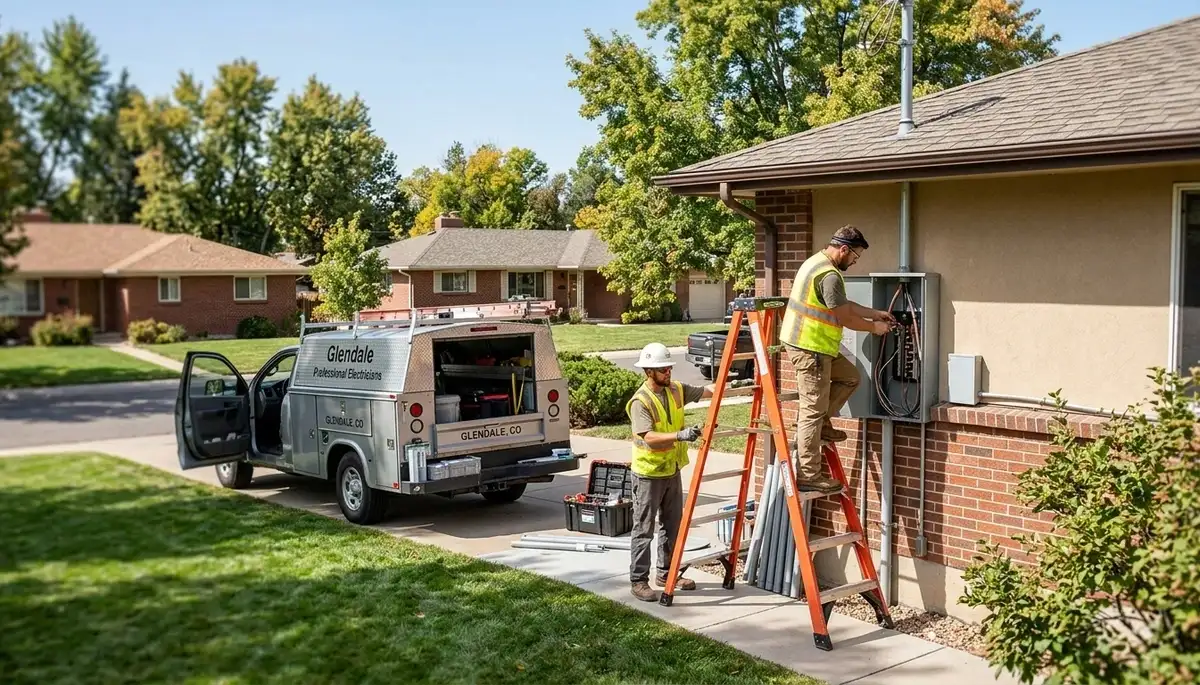
Most of the houses in Glendale went up through the fifties and sixties, a period when a sixty-amp panel was standard, two-prong outlets were code, and aluminum wiring had not yet been introduced. Three things follow from that: the panels are full or nearly full, the outlets in most rooms have no ground, and the circuits were drawn for a load that no longer reflects how these homes are used.
Breaker Box Full, No Room Left
A homeowner notices it when an electrician opens the panel and every slot is taken. Behind that is a sixty- or hundred-amp box installed when the house had one window unit and no dishwasher. A full panel cannot accept a new circuit, and doubling up breakers is a fire risk.
Local electricians correct this by replacing the original box with one sized for today's load and pulling a new service where the existing one cannot support it. The same work is handled for homeowners calling about electrical contractor in Aurora, CO.
Two-Prong Outlets Throughout the House
A homeowner sees two-prong receptacles in every room and reaches for an adapter to plug in anything modern. Behind it is wiring installed before grounding was required, which means the outlets have no path to carry a fault safely away from the device plugged into them.
Local electricians replace two-prong outlets with grounded receptacles where new wire can be run, and install outlets with test and reset buttons where running new wire through finished walls is not practical. Either fix removes the risk the ungrounded outlet carries.
Circuits That Trip When Two Things Run
A homeowner notices it in the kitchen: the coffee maker and the toaster run fine alone, but together they trip the breaker. What is behind it is a house where the kitchen was served by one or two circuits, drawn at a time when a kitchen had fewer appliances and none of them drew as much power as a modern one does.
Adding dedicated circuits for the appliances that trip the breaker stops the nuisance and removes the temptation to plug into an extension cord as a permanent fix. Two things improve at once: the kitchen works without interruption and the panel load spreads across circuits it was meant to carry.
A Service Sized for a Much Smaller Load
A homeowner adds a car charger in the garage or a new air conditioning unit and notices that lights dim when the compressor starts. The service running to the house was sized for what the house had when it was built, and a charger or a central air unit draws more than the whole original load did. Hot weather pushes the air conditioning harder and the problem becomes impossible to ignore.
Local electricians add capacity by upgrading the service entrance and replacing the panel, then confirm that the circuits feeding the new equipment are drawn correctly. After that work, the homeowner can run the charger, the air conditioning, and the kitchen without watching the lights.
Tight Access and Finished Walls
A homeowner wants a new circuit run to a back bedroom or a garage, and the path there goes through finished walls, a finished ceiling, or a crawlspace with limited clearance. The physical constraint is not the circuit itself but getting wire to where it needs to go without opening every wall between the panel and the destination.
Local electricians plan the path before the work starts, use the crawlspace or attic where access exists, and limit wall cuts to what the job actually requires. Work is done with the least disruption the house layout allows, and surfaces are left ready for a straightforward patch.
Call (720) 999-9594 to arrange a no-pressure visit from a local electrician who can look at the panel, the outlets, and the circuits and tell the homeowner exactly what the house needs.
On Call Electrical brings work that holds to every Glendale home it serves.

Electrical Services Available Across Glendale, CO
The list below covers the range of electrical work available to homeowners in Glendale, CO. Find what fits the situation and call to talk through it.
Urgent Electrical Work in Glendale, CO
- Electrical Repair - A breaker that will not reset or an outlet that stopped working in a house where the wiring has been in place for decades.
- Outlet Repair - Two-prong receptacles or outlets warm to the touch that need attention before they become a hazard.
- Switch Repair - A switch that sparks, feels loose, or no longer controls the fixture it was wired for.
- GFCI Circuits - Bathrooms and kitchens in these houses that were never fitted with outlets carrying test and reset buttons.
- Electrical Service - A service entrance that cannot handle what the house is running and needs to be brought up to what the load requires.
If any of these match what is happening in the house right now, a local electrician can look at it the same day.
Capacity and Wiring Work in Glendale, CO
- Electrical Panel Upgrade - A sixty- or hundred-amp panel with no empty slots left, installed when the house had a fraction of today's load.
- Electrical Panel Installation - Replacing a fuse box or an original breaker panel that can no longer be safely expanded.
- Electrical Wiring - Old wiring that has worn insulation, undersized conductors, or connections that were never made to last this long.
- New Construction Wiring - An addition or a finished basement that needs circuits drawn from scratch to match how the space will be used.
- Generator Installation - A house that loses power and has no backup, where a generator tied to the panel keeps the essentials running.
These houses were wired for a load that no longer reflects how they are lived in, and bringing the panel and wiring up to that load is the foundation of everything else.
Safety and Protection Work in Glendale, CO
- Smoke Detector Installation - Houses built before detection was required, where working detectors need to be placed in every sleeping area and hallway.
- Fire Alarm Installation - A step beyond individual detectors, connecting protection across the whole house so one alarm reaches every room.
- Whole Home Surge Protection - A single surge event can damage every appliance and device in the house; protection at the panel stops it before it reaches the wiring.
- Lightning Surge Protection - A direct or nearby strike sends a spike through the service entrance that unprotected panels and appliances cannot survive.
- Home Electrical Inspections - A full look at the panel, the wiring, and the outlets in a house that has not been inspected since it was built.
Safety work in these houses is not optional. A panel that was installed fifty years ago and has never been inspected is carrying risks the homeowner cannot see from the outside, and getting it looked at is the first step toward knowing what the house actually needs.
Lighting, Outdoor, and Added-Load Work in Glendale, CO
- Recessed Lighting Installation - Rooms in these houses that were wired for a single ceiling fixture and now need light spread across the whole ceiling.
- Landscape Lighting - Outdoor runs to yard lighting in houses where the exterior circuits were never drawn for anything beyond a porch light.
- Security Lights - Motion-activated lighting on the exterior of a detached house where the back of the property has no coverage after dark.
- Electric Car Charger Installation - A garage circuit that was sized for a single light and now needs to carry a charger drawing many times that load.
- Pool Pumps - Pool equipment added to a house whose original service was never sized for a pump running on its own dedicated circuit.
These houses are being asked to carry loads that did not exist when they were built, and running the right circuits for each one keeps the panel balanced and the equipment working the way it should.